Riverside Park’s courts run on a crew and a group chat.
On the Upper West Side, pickleball joined a busy recreation level. What keeps it playable is a conservancy maintenance crew, donors and a player-run user group.
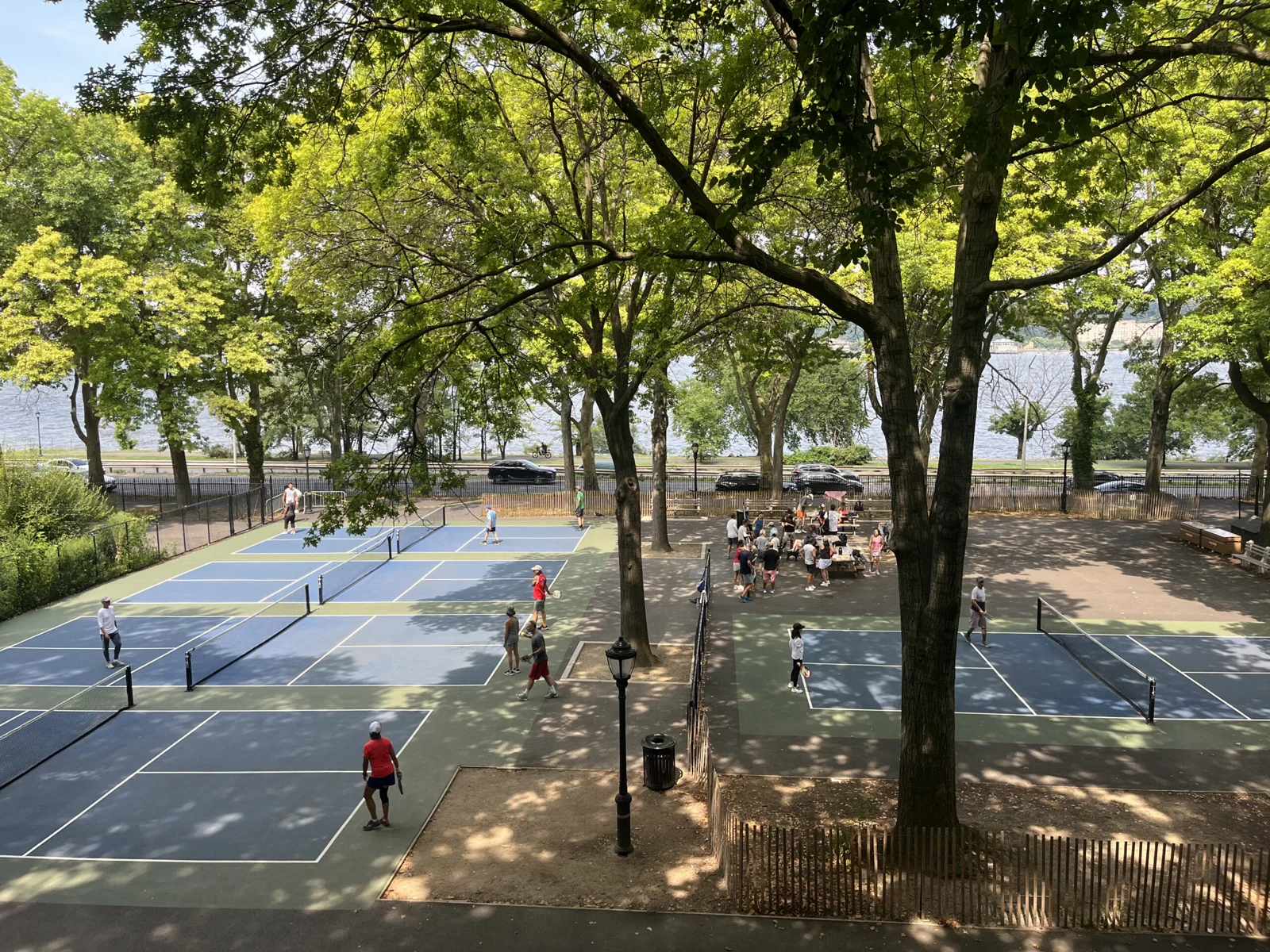
Riverside Park’s recreation level already had basketball, baseball, volleyball, soccer, handball and skateboarding. Pickleball is the newest arrival, and the Riverside Park Conservancy says it has “quickly become a new neighborhood favorite.”1
The Conservancy’s pickleball page is short, but it answers a question that most court announcements skip: who looks after the courts once they open?
The crew behind the courts
The Conservancy is direct that “city resources alone aren’t enough” for the wear and tear of heavy use. The new pickleball courts, along with Riverside Park’s 29 other courts and playing fields, are looked after by its Ballfields Crew, which it recently expanded to meet demand. The crew works seven days a week to keep the areas clear of trash and debris and safe to play, and it also looks after a newly installed portable bathroom at 110th Street.1
That work is partly paid for by players and neighbors. Donations made on the pickleball page go to a dedicated fund for the crew, and the Conservancy lists named supporters at different giving levels.1 It is a model worth noticing: a public court, maintained by a nonprofit, with a funding line that players can see.
How players organize themselves
The day-to-day community runs through a user group. The Conservancy points players to the Riverside Park pickleball group by email and to a TeamReach group with the code RiversidePark.1 For a newcomer, that is the practical front door: it is where you learn when the courts are busy, how rotation works and who to play with.
The group also runs events. The Conservancy’s page thanks everyone who took part in its Halloween Pickleball Tournament.1
What we could not confirm
An earlier version of this story in our reader gave a court count, sound measurements and a “community compact.” The Conservancy’s page does not state those, and we have removed them. How many courts are open, and when, is best checked with the user group or in person.
Municipal Planning & Facility Capital Horizons
Beyond the immediate scheduling schedule, this facility illustrates the broader capital equation facing modern municipal planners. Converting public asphalt to dedicated court layouts is no longer an isolated park experiment; it represents a fundamental re-rating of recreational space efficiency.1 Where traditional tennis layouts support four players across 7,200 square feet, a multi-court pickleball footprint accommodates sixteen or more concurrent participants, quadrupling hourly throughput while concentrating court-wear dynamics on high-friction zones.1
For city agencies and concession operators, the ongoing operational bottleneck remains sound ecology and off-peak throughput management. High-frequency paddle impact at 1.2 kHz requires deliberate acoustic buffering, and the surrounding neighborhood stakeholders increasingly demand sound-mitigation curtains, verified decibel monitoring, and structured ladder rotations before greenlighting additional capital permits.1 As public recreation departments balance dedicated access against legacy court reservations, this location serves as a critical benchmark for urban density planning across the regional sports network.1
Sources
Every fact above comes from these public pages. Open the original to check it, or to read further.
- Riverside Park ConservancyRiverside Park PickleballCaptured Sep 27, 2026
Chapter 02 · New YorkRead it in the issue →